What the Fellowship is doing
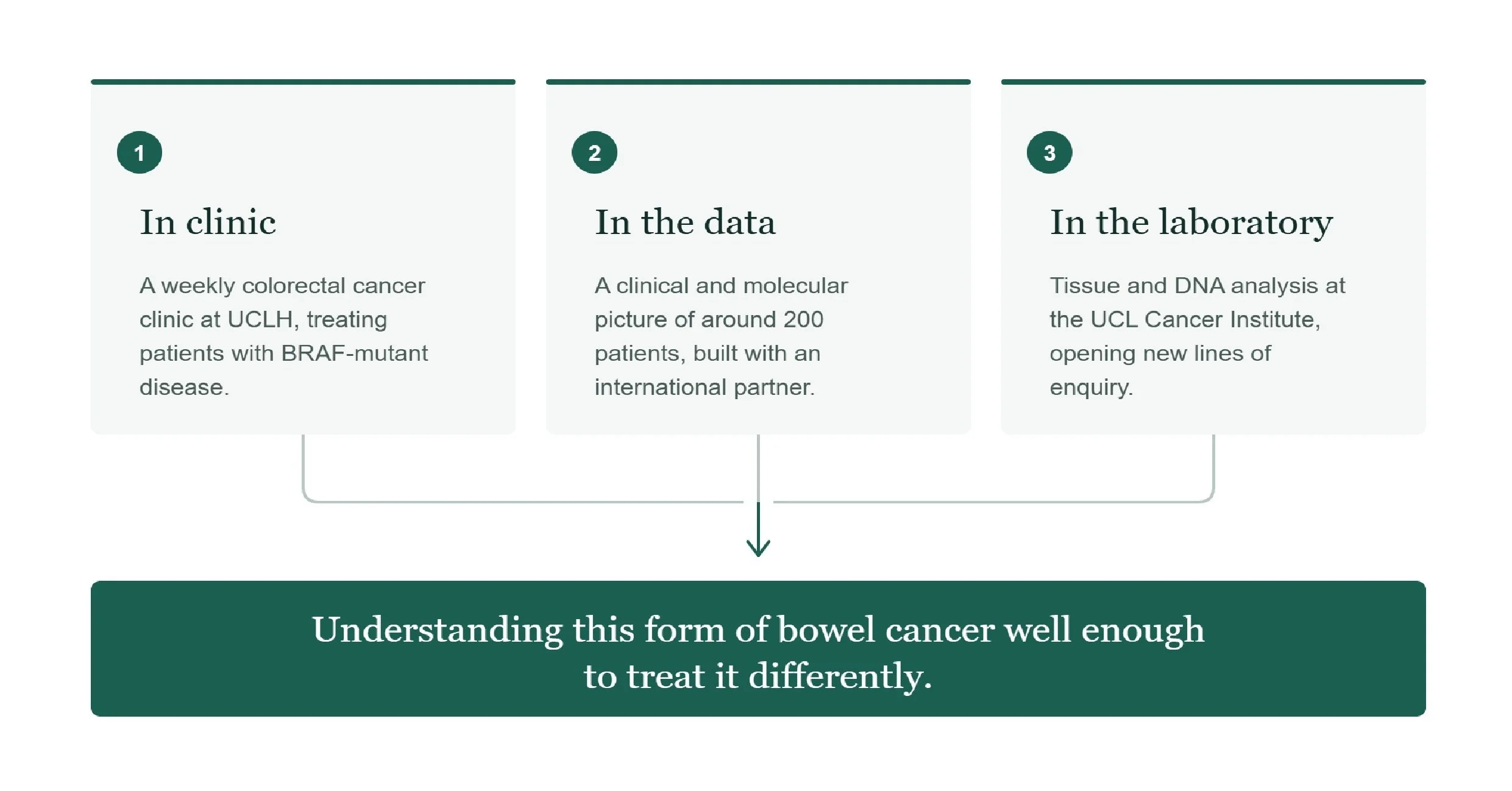
The Fellowship funds a year of combined clinical and research work on BRAF-mutant bowel cancer, built so that the two feed each other. Our Fellow, Aarav Gupta-Kaistha, treats patients in clinic at UCLH under Dr Khurum Khan, and works in the laboratory at the UCL Cancer Institute under Professor Marnix Jansen.
The aim is to understand this form of the disease well enough to treat it differently — and in the first year we have set out to do four things.
Build the picture. A detailed clinical and molecular dataset of around 200 BRAF patients treated at UCLH: how their disease behaves, how it responds, and how it eventually finds a way around the drugs we have.
Seek data beyond the UK. A collaboration with a major US centre, where patients are profiled at multiple points through treatment, will combine their data with ours. Findings in a rare subtype only become reliable at scale, and this roughly doubles what we can learn.
Open a new line of enquiry. Almost all research on this disease has focused on how the mutation drives the cancer. We are also asking whether some patients’ immune systems already recognise these tumours — a question that, if answered well, points toward treatments not currently offered to these patients.
Publish and present. Two to three papers in high-quality journals, and findings presented at one of the two major international oncology conferences. In research, published work is what turns a local finding into something other teams build on.
Together these give us what a clinical trial has to be built on. And they produce something else: a specialist oncologist equipped to spend a career on this disease, and positioned to win funding for a three-year PhD that takes the work further.
This is how we hope that Nicola’s legacy can support progress in cancer research — not in a single breakthrough, but in steps that accumulate until the standard of care moves. For example, the treatment that is now standard for BRAF-mutant bowel cancer exists because of exactly that process. We really hope we can add to this.
Why are we doing it?
Colorectal cancer is the 4th most common cancer in the UK and unfortunately, there is a rising incidence of early onset colorectal cancer at present. Currently, the majority of people with advanced colorectal cancer will receive standard treatments (a combination of chemotherapy agents +/- an additional targeted agent) that may not account for the complex differences in the biology of their disease. We know that patients with BRAF mutant disease respond less well to these standard treatments. Novel therapies such as immunotherapy are only available in clinical trials or for those with mismatch repair deficient disease (which affects approximately 4-7% of patients).
It can be argued that every patient's cancer is as unique as the patient themselves. Personalised oncology aims to offer treatment in a tailored manner matching appropriate treatments to both patient and cancer related factors. The more we can understand and classify a patient's cancer, the more tailored, specific and effective our treatments can be. Current examples of profiling a patient’s tumour include: staining for the expression of specific proteins, sequencing for molecular alterations, and visualizing slides under a microscope, all of which guide clinicians on how to treat a particular cancer. An example of this is the approval of the combination of drugs Encorafenib and Cetuximab for BRAF mutant colorectal cancers specifically, as these target a signalling pathway that is more prevalent in BRAF mutated colorectal cancers compared to non-BRAF mutated colorectal cancers.
There are lots of features that BRAF mutated colorectal cancers demonstrate that are associated with sensitivity to immunotherapy. However, in patients with what we call mismatch repair proficiency (which accounts for approximately 80% of BRAF colorectal cancer patients), this potential sensitivity to immunotherapy is not reflected in clinical trials and outcomes. The key aim of our laboratory work through the Nicola Karayannis Fellowship is to characterize and understand more about the presence of immune cells in BRAF tissue samples and correlate these findings to additional patient and tumour related factors. This work will allow us to assess whether we can identify an additional group of BRAF patients who may benefit from immunotherapy as part of their treatment paradigm, supporting a more personalized treatment approach.
Fellowship Updates
Regular updates on the Fellowship will appear here.